
Verify Student Understanding at Scale

Oral assessment verification that scales: Students demonstrate understanding of their submitted work through recorded asynchronous vivas.

VivaEdu platform illustration

The Problem, Quantified

Every student uses AI, and education currently lacks an efficient way to verify authentic understanding, with institutions having no scalable way to verify. In‑person Q&A verifications, while still the gold standard assessment method, cost immeasurable time and money for each suspected AI case.

According to the Digital Education Council Global AI Faculty Survey 2025, 54% of faculty believe that current student assessments require significant change. Source (PDF)

Over 50% of students say over‑reliance on AI harms performance and reduces the value they receive. Source

50% of faculty members say assignments should be redesigned to be more AI‑resistant. Source (PDF)

Our solution: Scalable Oral Assessments to Adapt to AI

Brief, asynchronous reflections let students evidence their own understanding. It can be utilized and applied to any scenario. It can be used to authenticate what was already submitted, or serve as its own standalone, class-wide assignment. Here's an example of how it can seamlessly fit into the grading flow:

  1. Step 1

    Flag submissions for verification

    During grading, instantly flag any submission for understanding checks with one click, or batch assign viva assignments for the entire cohort.

  2. Step 2

    Students verify their understanding

    Brief, asynchronous oral assessment authentication of understanding that can be completed anywhere, anytime. First they receive the question, unseen to ensure minimal prep time to use AI, and then they record their responses in a stress-free, proctoring-free environment.

  3. Step 3

    Confirm authenticity & finalize grades

    Instructors can review the student's recorded videos in VivaEdu itself, or quickly scan the sophisticated speech-to-text transcripts of their responses that attach directly to original submissions inside any LMS.

VivaEdu Academic Integrity Verification Demo

Evidence that scaled oral exams are the true adaptation to AI use in education.

Oral questions lift performance

Vivas raise scores, fast. In a UC San Diego trial, students who took a 15-minute oral exam with the instructor scored 14% higher on the next written test; motivation also rose, especially for first-generation students.

UC San Diego Today

Digital tools now used by most students

HEPI/Kortext 2025: usage jumped from 66%→92% in one year; 88% have used GenAI for assessments

HEPI/Kortext Survey (PDF)

Heavier tool reliance, weaker thinking

Study of 666 participants found heavy reliance on assistants is strongly negatively correlated with critical-thinking scores (r ≈ −0.68), mediated by cognitive offloading

MDPI Study

Verification in One Click, Right Where You Grade

Flag any submission for verification while grading, or create your own viva assignment quickly and seamlessly within your LMS. Not a time-consuming new tool to learn!

Designed for speed

Flag individual submissions during grading for verification or set cohort-wide vivas upfront. Students record a brief reflection; transcripts auto‑attach to the original submission in your LMS. No extra tools, no meetings.

Defensible integrity

Students explain their reasoning in their own words. You get the authentic voice of the student, not ChatGPT.

Employability and confidence

VivaEdu addresses the immediate integrity crisis and gives students space to articulate their thinking, building confident communicators and stronger graduates.

Why VivaEdu - Benefits Overview
Educator Preview
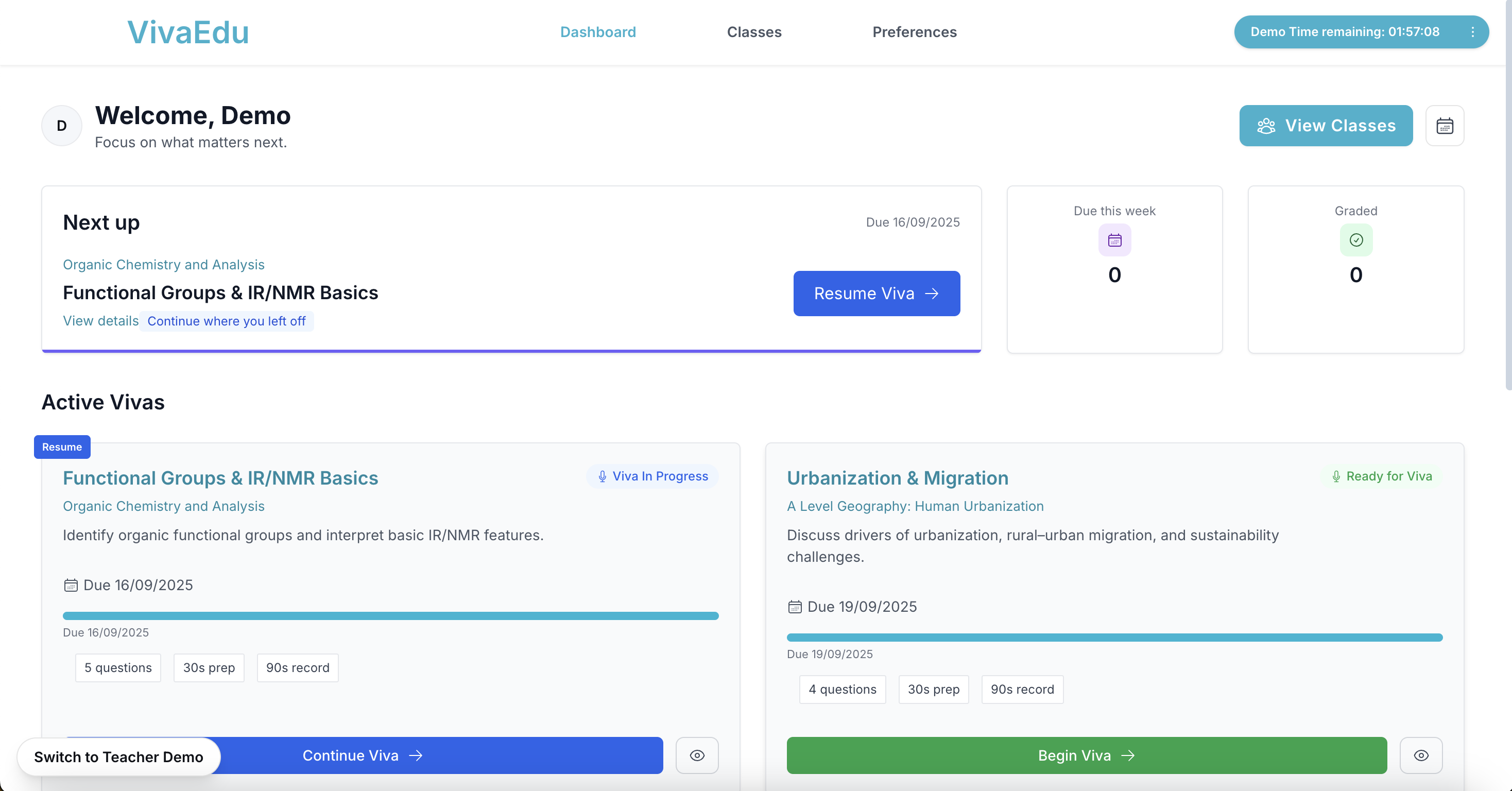
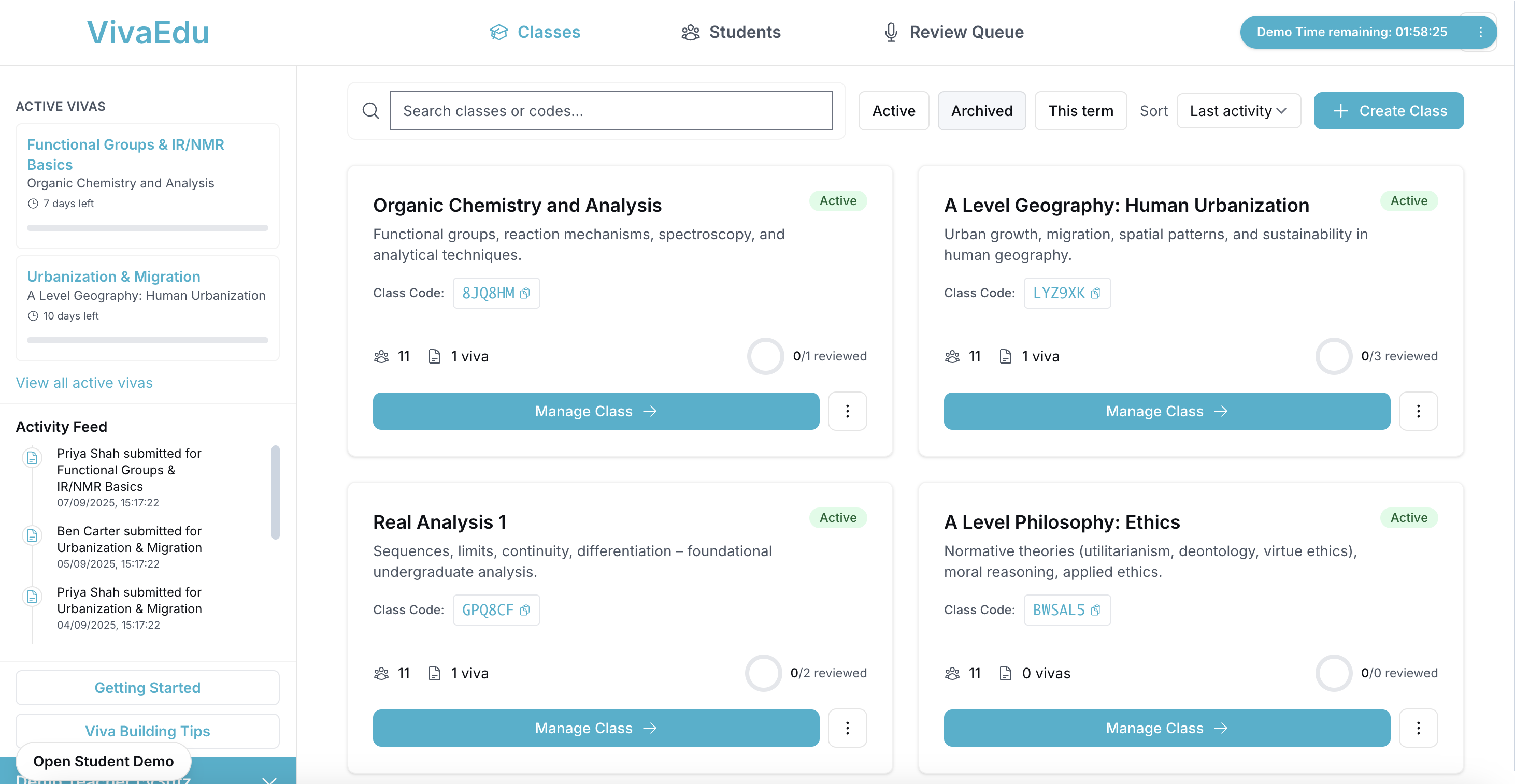
Educator dashboard preview
Student Preview
Student workflow preview
Prompt Guide

Create Questions to Verify True Understanding

VivaEdu guides students through brief, contextual reflections on their submitted work to validate understanding. Here are some great example questions.

Prompt

Walk me through your main argument

Prompt

Which part are you most confident about?

Prompt

Clarify what you meant on page 3 about...

Prompt

How did you approach this analysis?

Prompt

Address a potential counter‑argument

Prompt

What do you consider to be the single strongest piece of evidence you used, and why?

Background

Traditional Post‑Grading Verification Vs VivaEdu

Time
Traditional
Schedule 20‑min meetings with each flagged student.
VivaEdu
Students record 3–5 min reflections asynchronously.
Process
Traditional
Coordinate schedules, book rooms, document outcomes manually.
VivaEdu
One‑click while grading; transcripts auto‑attach for a complete record.
Scale
Traditional
Can only verify 5–10 cases per term due to time and cost.
VivaEdu
Verify 30–50% of submissions efficiently.
Coverage
Traditional
Most suspicious cases are ignored due to effort required.
VivaEdu
Check understanding across entire cohorts.
Workflow

Works with your existing workflow

Flag suspicious submissions during normal grading. No need to pre‑plan or restructure assessments. VivaEdu fits into your academic misconduct procedures, not the other way around.

LMS Integrations

Canvas • Blackboard • Moodle (LTI 1.3 compliant)

Instructors, educators, and TAs can also sign in to the web app for accessible management and review outside the LMS.

Accessibility & Accommodations

  • Screen reader support & keyboard navigation
  • Extensions, multilingual options in the works
  • Extra time, pause/resume, flexible retries
  • Typing‑based alternative available

Integrity signals (privacy‑first)

  • Tab‑switch detection
  • Session anomaly flags

Optional, giving educators full control over additional checkers

Graduation background

Pilot VivaEdu!

Interested in piloting VivaEdu? Reach out to join our early‑access schools and universities.Reach out to usfor the 2025–2026 academic year. It is completely free of charge.

Founders

Jex Pearce
CTO • Mathematics
Ben Arkus
advisory member • Philosophy (BA)
LinkedIn
Durham graduates with teaching experience who’ve seen technology transform education firsthand

Trusted, secure, and privacy‑first

GDPR and DPA‑aligned. LTI 1.3.